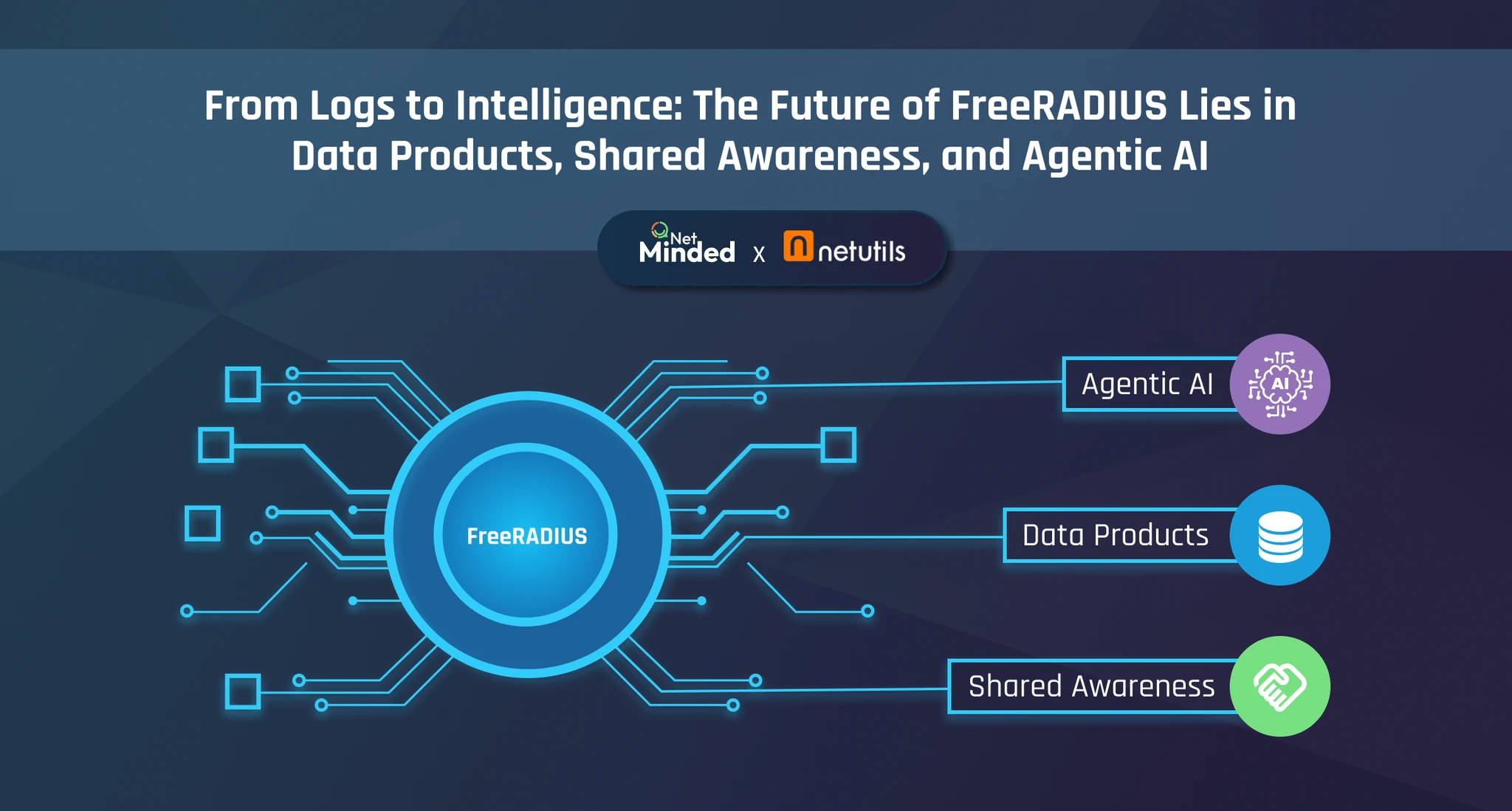
The Future of FreeRADIUS Lies in Data Products, Shared Awareness, and Agentic AI
FreeRADIUS is everywhere. It silently authenticates millions of devices every second across Wi-Fi networks, VPNs, enterprise identities, guest access, and IoT fleets. It is the invisible checkpoint that decides who gets onto a network, when, and how.
And yet, from an operational perspective, FreeRADIUS remains one of the least visible critical services.
If something goes wrong, such as timeouts, bad policies, IdP slowness, or device-client bugs, operators often piece together clues manually from syslog, raddebug, accounting traces, or frustrated user complaints.
But what if RADIUS could speak?
What if it could tell you, in real time:
This is not wishful thinking. It is the natural evolution enabled by MNOC/SMX data products, privacy-preserving data sharing, and agentic AI.
Let’s explore what this looks like.
Every Access-Request, Accept, or Reject contains the story of a user’s experience:
Yet almost none of this becomes meaningful telemetry.
Operators typically see:
But they do not see experience.
They do not see intent.
They do not see patterns.
And they cannot see “is it just us?” without looking outward.
NetMinded’s MNOC/SMX architecture treats each domain of operations, from Y.1731 Ethernet OAM to syslog to gNMI, as scored, enriched, first-class data products.
FreeRADIUS fits this perfectly.
A single authentication event becomes a data product when enriched with:
These are then wrapped into experience scoring:
Scored data products allow operators to see:
They turn FreeRADIUS into something it has never been before:
a user experience telemetry source.
FreeRADIUS is deployed in silos.
Each customer sees only their own logs.
But a huge amount of operational pain is shared:
Most operators discover these only through:
With SMX-style federation, organisations can share insights without sharing data.
They share:
They do not share:
This creates a new operational concept:
“Am I the only one seeing this?” becomes
“We see what our peer group sees.”
A cluster of shared signals might say:
This is MNOC’s shared awareness applied to authentication.
Once FreeRADIUS emits structured, scored data, an AI agent can do the jobs humans currently perform manually.
When a user calls:
“Tell me about user alice@example.com over the last 24 hours.”
The AI summarises:
It suggests advising the user to reset their password.
Answers questions such as:
Generates:
The AI becomes a shared, federated sense-maker across FreeRADIUS estates.
FreeRADIUS is already a world-class AAA server.
The next evolution is to make it a world-class operational intelligence source.
This happens when we:
This transforms
And importantly, this is achievable right now with minimal changes to FreeRADIUS itself.
Authentication is the first moment a user experiences a network.
If logging in is slow, confusing, or broken, everything else is irrelevant.
MNOC/SMX combined with agentic AI unlocks:
Most organisations already have the data.They simply need a way to turn it into insight, and a way to share awareness without sharing secrets.
FreeRADIUS has always been foundational.
But in a world of rising authentication complexity, including Wi-Fi 6 and 7, BYOD, SSO and IdP chains, and zero trust, operators need more than logs.
They need awareness.
They need explainability.
They need intelligence.
By treating FreeRADIUS outputs as data products, and enabling federated, privacy-safe sharing, we can give every operator something they have never had before:
A complete picture of login experience across time, across systems, and across organisations.
And with agentic AI, we can go further still:
turn RADIUS into an active participant in operations, not a passive back-end component.
NetUtils are a UK managed service provider and systems integrator with over thirty years’ experience securing and supporting business critical networks. They help organisations reduce risk, strengthen resilience and simplify their IT operations through a security-first approach.
Their specialist AAA Radius products and services ensure secure, standards-based authentication across wired and wireless environments, giving IT teams the visibility and control they need to protect user access at scale. Delivered by experienced network and security engineers, their Radius solutions integrate cleanly with existing infrastructure and form a core part of a Zero Trust strategy.
From networking and cloud to endpoint protection and 24/7 managed security, NetUtils deliver trusted solutions built on responsiveness, expertise and measurable outcomes.
netutils.com
NetMinded is a UK-based technology company that helps network operators, ISPs, and MSPs understand what is really happening in their networks, in real time and with confidence.
Modern networks already generate vast amounts of telemetry, but raw data alone does not deliver resilience, assurance, or regulatory confidence. NetMinded turns low-level signals such as ICMP, Y.1731, RFC 6349 indicators, and device telemetry into structured data products with built-in context, scoring, and evidence.
Our focus is on shared awareness. We enable multiple parties to safely contribute, compare, and reason over network signals while respecting privacy, security, and commercial sensitivity. This allows organisations to move faster during incidents, establish clearer accountability, and provide credible, evidence-backed answers to operational and regulatory questions, while complementing existing tools and operational models rather than replacing them.


CONTACT US TODAY
Discover how NetUtils can help protect your business from cyber threats and streamline your IT operations. Our team is ready to provide you with the support and solutions you need to thrive.

Email Us
info@netutils.com
Call Us
020 8783 3800Subscribe to our quarterly threat report for the latest updates on cybersecurity trends, tips, and solutions.


The Larches, Sevenoaks Road, Orpington, Kent, BR6 7FB


Copyright © 2024 Network Utilities (Systems) Ltd. All rights reserved